Git Conventions
How we name branches, write commits, and run pull requests at GoodFit.
Branches
- Default branch:
main. Feature branches are QAed ondevfirst, then merged intomainvia PR, which auto-deploys tostagfor release QA. Production is then released by opening amain→prodPR once that QA passes. See Development Lifecycle for the full picture. - Naming:
<ticket>/<short-description>— e.g.GFENG-123/new-column-migration.
For longer-lived work split across multiple PRs, see the Feature & Sub-branches guide.
Commit messages
Prefix each commit with the ticket number:
GFENG-1234: Add migration for new column
Keep the subject short; add detail in the body if the change isn't self-evident from the diff.
Pull requests
Opening a PR
-
Open the PR on GitHub.
-
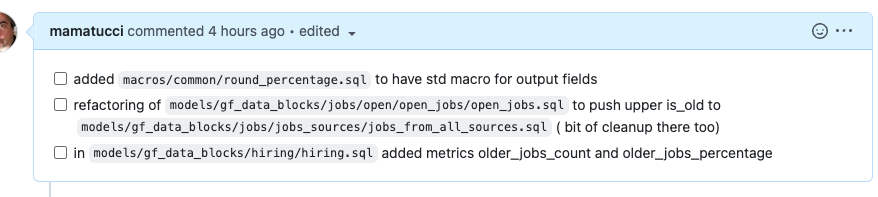
Add a summary describing what changed and why.
- Summary
- What changed and why. Link to ticket:
GFENG-123.
- What changed and why. Link to ticket:
- Changes
- [Bullet list of user-visible or system-visible changes]
- (optional) test notes — e.g. a SQL snippet so reviewers can re-run your verification.
- Summary
-
Post in #eng-prs with the PR link and the name shown in "Changed files".

Handling review comments
When a conversation is opened on your PR:
- Reactions are fine when you just agree with a change — no need to reply.
- Comments belong on anything unclear or anything you disagree with.
- Maintainers should make it explicit whether a comment is blocking or just a suggestion/question.
- Reviewers resolve their own threads. Authors leave threads open and reply with a quick note (e.g. "Updated here: 2dea449") so the reviewer can verify and close.
- We favour velocity over process for process' sake.
(optional) After pushing follow-up commits, paste the commit hash as a thread reply. Expect a reaction (💚 💛 👀) when it's been seen.

Merging
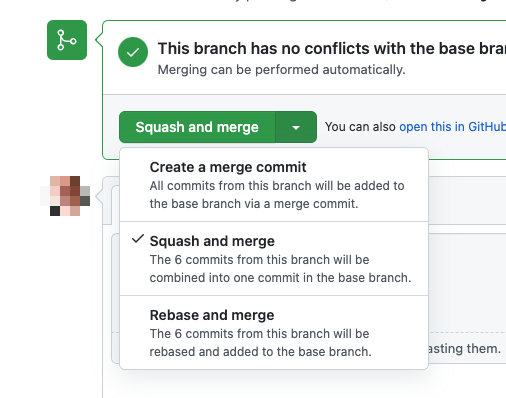
Once approved, choose Squash and merge or Merge commit at your discretion — pick whichever produces the more useful history for the change.
Why we work this way
A small amount of structure keeps the review loop tight:
- Reviewers get a clean signal when updates are ready for another look.
- Authors don't have to guess whether something is "done" or still under discussion.
- Maintainers can verify follow-up changes without re-reading the entire diff.
- Feedback stays fast, especially with multiple reviewers.
Tiny bit of structure → smoother reviews → fewer "wait, was this addressed?" moments.